Subterranean termite treatment in Dallas requires continuous structural containment adapted to the expansive clay soils native to north Texas. Eastern subterranean termites feed on internal framing timber, building…
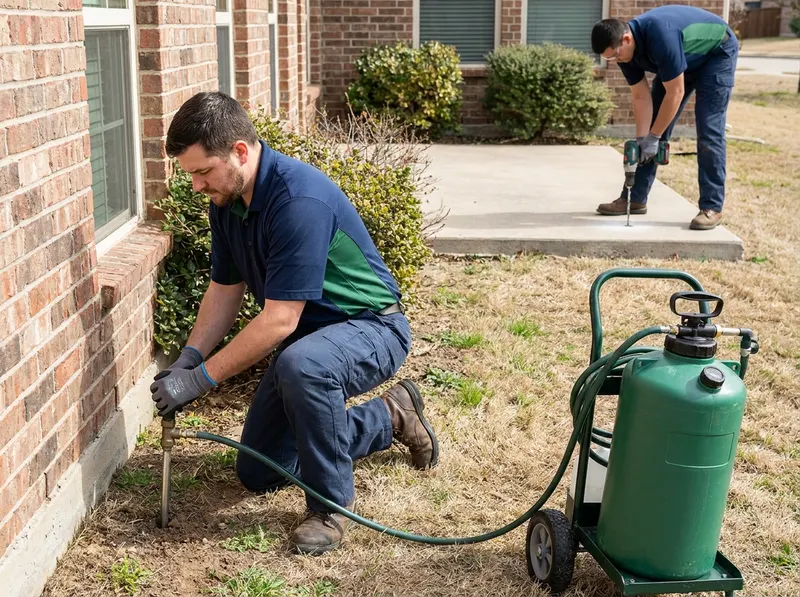
Subterranean termite treatment in Dallas requires continuous structural containment adapted to the expansive clay soils native to north Texas. Eastern subterranean termites feed on internal framing timber, building concealed mud shelter tubes over concrete stem walls and crawlspace piers. In historic raised-floor dwellings in Oak Cliff and Kessler Park, settling pier-and-beam foundations create hidden ground-to-wood contact points where colonies enter undetected. Slab-on-grade homes throughout Lake Highlands and Far North Dallas frequently experience perimeter entry through plumbing penetrations and expansion joints, where soil shifting breaks previous barrier applications. Ground applications adhere strictly to standards issued by the Texas Department of Agriculture for structural pest control, ensuring precise volume-per-linear-foot compliance without indiscriminate broadcast spraying.
Effective colony termination relies on non-repellent liquid termiticides such as fipronil, which workers track back to the subterranean nursery. Because foraging insects cannot detect the active ingredient, social grooming spreads the agent throughout the subterranean network, causing total colony elimination within 60 to 90 days. For properties situated near sensitive hydrological zones like White Rock Lake or the Dallas Arboretum and Botanical Garden, an exterior baiting matrix offers a targeted alternative. Tamper-resistant stations containing noviflumuron interrupt the insect molting cycle, documented thoroughly in technical bulletins from the United States Environmental Protection Agency. The operational trade-off centers on intervention speed versus site impact: liquid barrier applications establish an immediate defensive zone via trenching and sub-slab drilling, whereas baiting systems require zero concrete drilling but demand regular quarterly monitoring to verify consumption rates.
Structural defense succeeds only when paired with environmental remediation. Subterranean species require ambient moisture levels above 70% to avoid desiccation, meaning grading faults and irrigation leaks directly accelerate pest pressure. Properties near Klyde Warren Park, Uptown, and the Bishop Arts District with elevated moisture profiles around exterior perimeters require corrected drainage to prevent wash-out of treated soil matrices. Structural protection protocols incorporate the building integrity metrics established by the National Institute of Standards and Technology alongside wood-preservation frameworks defined by the American Wood Protection Association. By combining perimeter exclusion with precise chemical barrier placement, structural frames remain completely insulated from subsurface wood-destroying organisms.
1. A structural assessment maps active mud tubes, interior wall void damage, and exterior foundation access points across the structure's perimeter.
2. Soil is trenched 6 inches wide and 6 inches deep around exterior foundation walls, applying 4 gallons of non-repellent termiticide per 10 linear feet pursuant to Occupational Safety and Health Administration handling rules.
3. Slab penetrations, expansion joints, and attached garage aprons undergo 0.5-inch vertical drilling every 12 inches to disperse liquid barriers beneath the concrete footing.
4. Interior plumbing access points and sub-floor areas receive targeted low-pressure foam treatments conforming to U.S. Department of Housing and Urban Development wood protection guidelines.
5. Exterior monitoring stations installed flush with turf lines integrate U.S. Department of Agriculture Forest Service termite management research to ensure sustained boundary containment.
Every job gets a firm, written price after a free on-site visit.
For standards, safe disposal, and service guidance on pest control services in Dallas, TX, useful references include U.S. EPA, ENERGY STAR, U.S. Dept. of Energy, Consumer.gov, U.S. Census Bureau, and Google Maps. General consumer and small-business resources are available from USA.gov, Better Business Bureau, FTC Consumer Advice, U.S. Small Business Administration, and Ready.gov.
Tell us about your subterranean termite treatment job in Dallas and we'll send a clear, written quote, usually the same day.
 MeadowLock Pest Services