North Texas summers accelerate the reproductive cycles of social vespid species, creating aggressive territory defense near structural ingress points. In neighborhoods like Lake Highlands, Lakewood, and Preston Hollow,…
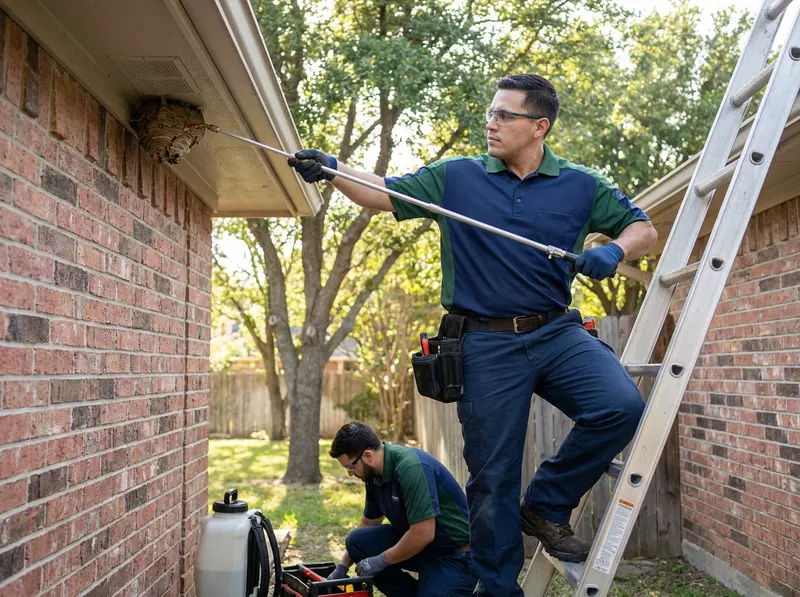
North Texas summers accelerate the reproductive cycles of social vespid species, creating aggressive territory defense near structural ingress points. In neighborhoods like Lake Highlands, Lakewood, and Preston Hollow, mature canopy growth and architectural cedar trim provide prime elevated harbors for red paper wasps (Texas A&M AgriLife Extension documents Polistes carolinus and Polistes metricus as dominant native paper wasps). In contrast, properties throughout Oak Cliff, Kessler Park, and the Bishop Arts District frequently experience aerial hornet hangs beneath wide bungalow eaves, while Far North Dallas properties with split brick construction repeatedly sustain subterranean or weep-hole colonizations by southern yellowjackets (Penn State Extension details the subterranean nesting behaviors of Vespula squamosa). Stinging insect and wasp abatement prioritizes the physical removal of the nest matrix combined with targeted micro-encapsulated formulations applied directly to anchor points, disrupting the pheromonal trace that guides fertile queens back to the exact architectural facet the following spring.
Over-the-counter pyrethroid aerosols consistently fail to solve established infestations because commercial spray solvents trigger rapid alarm pheromone release, causing defensive swarms without neutralizing developing larvae inside protective capped pupal cells (USDA Agricultural Research Service studies confirm vespid alarm pheromones initiate aggressive colony recruitment within seconds). Incomplete treatments by property owners often drive defensive colonies deeper into wall chases and attic cavities, exacerbating indoor sting hazards near HVAC vents. MeadowLock Pest Services manages stinging insect activity through methodical mechanical extraction, aerosolized void flushing, and barrier treatments governed by biological standards from the Entomological Society of America. Field technicians deploy specialized extension wands reaching up to 30 feet, eliminating ladder hazards while keeping non-target spaces free of drift, matching safety protocols established by the Occupational Safety and Health Administration.
Decision-fit for wasp management relies on nest location and colony maturity. A single exposed paper wasp umbrella beneath a first-floor patio header presents a straightforward physical takedown, whereas yellowjacket populations utilizing masonry weep tracks require specialized dust injection into brick voids followed by structural proofing. Weep screed exclusions employ corrosion-resistant copper mesh or ventilated stainless inserts approved under ASTM International wire specifications, preserving foundation ventilation required by City of Dallas Building Inspection codes while halting pest re-entry. Technicians verify perimeter security around outdoor living spaces, pool decks, and pergolas near White Rock Lake, the Dallas Arboretum and Botanical Garden, and the Trinity River Audubon Center, where natural water sources elevate local stinging insect forage rates.
All structural treatments strictly adhere to pesticide environmental handling criteria issued by the Environmental Protection Agency and structural pest regulations supervised by the Texas Department of Agriculture. Direct chemical treatments isolate active colonies to ensure companion animal safety, requiring pets and children to remain indoors only until liquid applications achieve complete dry-down, which averages 60 to 90 minutes under local ambient humidity. Homes bordering open greenbelts like Klyde Warren Park or Uptown commercial corridors receive thorough perimeter sealing to maintain strict separation between urban public green spaces and private structural boundaries.
Every job gets a firm, written price after a free on-site visit.
For standards, safe disposal, and service guidance on pest control services in Dallas, TX, useful references include U.S. EPA, ENERGY STAR, U.S. Dept. of Energy, Consumer.gov, U.S. Census Bureau, and Google Maps. General consumer and small-business resources are available from USA.gov, Better Business Bureau, FTC Consumer Advice, U.S. Small Business Administration, and Ready.gov.
Tell us about your stinging insect and wasp abatement job in Dallas and we'll send a clear, written quote, usually the same day.
 MeadowLock Pest Services