MeadowLock Pest Services approaches turf protection by establishing defined physical and biological boundaries against invasive Texas A&M AgriLife Extension confirmed threats, specifically the red imported fire ant. In…
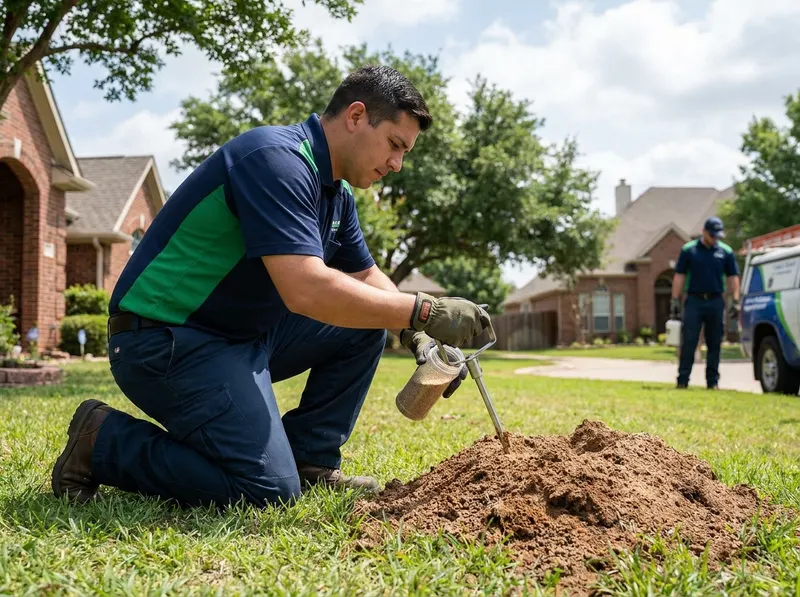
MeadowLock Pest Services approaches turf protection by establishing defined physical and biological boundaries against invasive Texas A&M AgriLife Extension confirmed threats, specifically the red imported fire ant. In North Texas regions characterized by heavy Houston black clay soils, common throughout Lakewood, Lake Highlands, and Far North Dallas, fire ant nests extend significantly deeper than the visible surface crater. During extreme summer heat, multi-queen (*polygyne*) colonies migrate downward up to 4 feet into soil fissures to protect reproductive chambers. Direct mound inoculation bypasses dry, compacted crust using pressurized root-zone injection rods, driving targeted active agents directly into subterranean galleries rather than washing over the surface where runoff enters local Dallas municipal watersheds as monitored by the City of Dallas.
Surface-spread consumer granules often fail because foraging worker ants frequently reject desiccated bait during triple-digit heat, while surface contact powders fail to penetrate beyond the top 3 inches of compacted clay. In older residential areas with mature tree canopies and expansive turf, such as Kessler Park and Preston Hollow, fire ants construct diffuse subterranean networks beneath landscape pavers, root flares, and decorative limestone retaining walls. Professional inoculation isolates these structural vulnerabilities. Inoculating individual subterranean voids with pressurized active treatments compliant with standards set by the US Environmental Protection Agency stops brood production at the queen level, avoiding the disruptive colony budding caused by off-the-shelf contact pyrethroids.
Decision guidance depends on yard infestation patterns and proximity to water tables or public parks. When managing residential grounds near White Rock Lake, the Dallas Arboretum and Botanical Garden, or properties bordering the Trinity River Audubon Center, targeted subsurface inoculation provides immediate spot remediation without broad environmental runoff risks. In comparison, general broadcast treatments alone require several weeks to show reductions and can leave active colonies intact if foraging drops off. MeadowLock Pest Services couples deep injection with targeted structural exclusion along foundational weep holes, crawlspace vents, and electrical junction boxes, protecting against perimeter breach using materials aligned with Texas Department of Agriculture commercial pest guidelines.
Execution follows an exact 4-step sequence: First, technicians map every visible active mound alongside hidden subterranean tunnels along landscape edges. Second, a pressurized injection probe delivers a calibrated volume of residual liquid termiticide/insecticide directly into the primary nursery chamber. Third, perimeter turf receives an insect growth regulator compliant with National Pesticide Information Center parameters to arrest worker pupation. Fourth, foundation perimeters are assessed for structural entry points, ensuring displaced workers cannot shelter within interior wall voids. For service inquiries or diagnostic site assessments, contact MeadowLock Pest Services at (469) 424-9120.
Every job gets a firm, written price after a free on-site visit.
For standards, safe disposal, and service guidance on pest control services in Dallas, TX, useful references include U.S. EPA, ENERGY STAR, U.S. Dept. of Energy, Consumer.gov, U.S. Census Bureau, and Google Maps. General consumer and small-business resources are available from USA.gov, Better Business Bureau, FTC Consumer Advice, U.S. Small Business Administration, and Ready.gov.
Tell us about your fire ant mound inoculation job in Dallas and we'll send a clear, written quote, usually the same day.
 MeadowLock Pest Services