Thermal eradication deploys industrial convective heaters and air-movers to elevate ambient indoor structural temperatures to a sustained range between 122°F and 135°F. Research by the U.S. Environmental Protection…
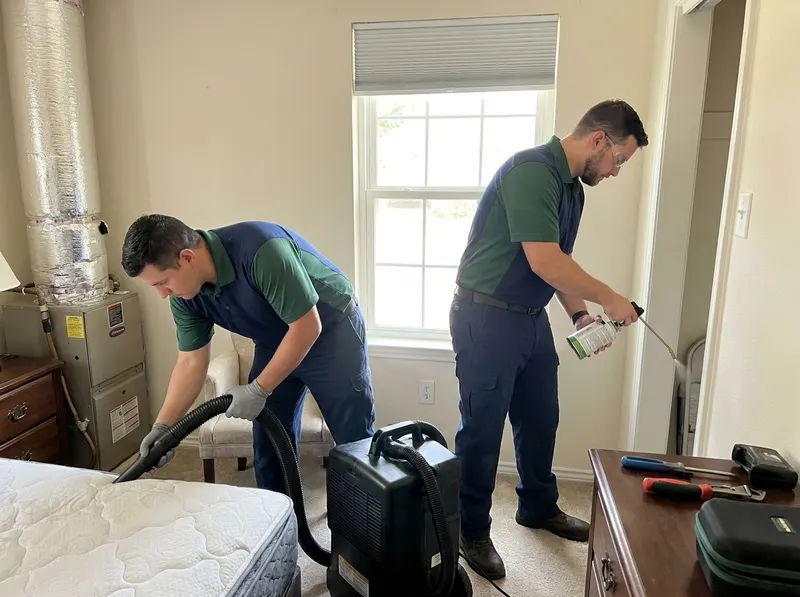
Thermal eradication deploys industrial convective heaters and air-movers to elevate ambient indoor structural temperatures to a sustained range between 122°F and 135°F. Research by the U.S. Environmental Protection Agency confirms that sustained core temperatures of 120°F induce rapid thermal death across all life stages of bed bugs within minutes, effectively penetrating wall voids, mattress cores, and deep subfloor cracks where topical sprays fail. While heat treats the interior atmosphere, pyrethroid and neonicotinoid resistance documented by the Texas A&M Department of Entomology necessitates a dual protocol. MeadowLock Pest Services pairs controlled thermal exposure with non-repellent residual liquid spot applications and desiccant dusts behind switch plates to establish perimeter barriers that intercept any migrating specimens seeking cooler perimeter wall insulation.
Selecting a hybrid thermal-chemical protocol over chemical-only treatments depends on infestation severity, clutter levels, and turnaround urgency. A standalone chemical protocol requires 3 to 4 visits spaced 14 days apart to target newly hatched nymphs, presenting ongoing bite risks and demanding repeated laundering. In contrast, whole-structure thermal remediation delivers single-day knockdown of mature adults and desiccation of egg clutches, though it demands rigorous pre-service preparation including the removal of heat-sensitive cosmetics, vinyl records, candles, and pressurized containers. For historic pier-and-beam foundations found in Oak Cliff and Kessler Park, supplemental barrier chemistry remains essential because loose floor planking allows heat to dissipate faster into crawl spaces than inside slab-on-grade builds in Far North Dallas.
Structural layout dictates treatment efficiency across Dallas County. In high-density multi-family settings across Uptown and the Bishop Arts District, electrical conduits and shared plumbing chases serve as transit corridors between units. Managing these spaces requires sealing access points per guidelines from the U.S. Department of Housing and Urban Development and applying targeted chemical barriers around shared utilities before heating begins to prevent lateral dispersal into adjacent tenant spaces. In sprawling residences throughout Preston Hollow and Lakewood, multi-zone HVAC ducting and vaulted ceilings require industrial-grade monitoring using infrared thermometry, verified against standards maintained by the National Institute of Standards and Technology. To safeguard domestic air quality after treatment, mechanical ventilation complies with indoor environmental clearances established by the National Institute for Occupational Safety and Health.
1. Structural diagnostic inspection: Technicians survey bedroom perimeters, upholstered furniture, and structural baseboards using high-lumen optical equipment to map live harborage zones.
2. Thermal preparation: Inhabitants remove heat-sensitive medications, aerosols, pets, and delicate vinyl materials before heavy equipment deployment.
3. High-output heat saturation: Technicians position forced-air convective units and thermal probes, raising ambient temperatures above 122°F for a minimum of 4 hours.
4. Precision residual application: Technicians inject non-repellent formulations into unheated peripheral thresholds, tack strips, and wall cavities to block structural egress.
5. Post-thermal monitoring: Sensor data verifies structural target saturation, followed by immediate mechanical cooling down to standard room temperature.
Every job gets a firm, written price after a free on-site visit.
For standards, safe disposal, and service guidance on pest control services in Dallas, TX, useful references include U.S. EPA, ENERGY STAR, U.S. Dept. of Energy, Consumer.gov, U.S. Census Bureau, and Google Maps. General consumer and small-business resources are available from USA.gov, Better Business Bureau, FTC Consumer Advice, U.S. Small Business Administration, and Ready.gov.
Tell us about your bed bug thermal and chemical eradication job in Dallas and we'll send a clear, written quote, usually the same day.
 MeadowLock Pest Services